

2026 Market Outlook | Freight Market Intelligence
By Circle Logistics • Published November 2026 • ~5-minute read
“October did not unwind the 2026 rate cycle. It split it. Van and reefer each gave back five cents, while step deck and Conestoga kept climbing. For shippers, the trailer your freight rides on now matters as much as the lane it moves in.”
Executive Summary
October split the truckload market in two. Van rates settled at $3.15 per mile, five cents off September’s record, and reefer eased the same five cents to $3.68. Standard flatbed also slipped to $3.84. For shippers who absorbed a record September, that is a welcome pause. However, it is a pause rather than a turn.
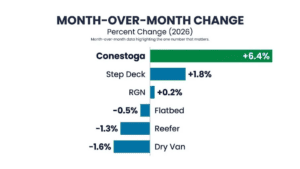
The year-over-year comparison tells the bigger story. Van still prices 37.6% above October 2025, and reefer sits 43.2% higher. Meanwhile, specialty open deck moved the other way entirely. Step deck rose to $4.65 per mile, now 79.5% above last year, and Conestoga jumped 6.4% as autumn weather put a premium on tarp protection.
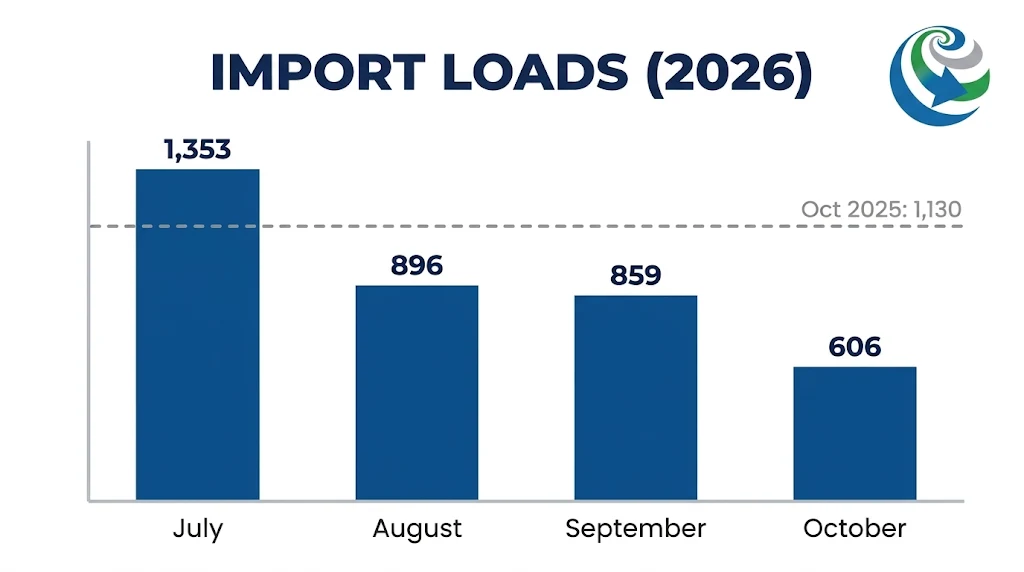
Two other signals point to a more balanced fourth quarter for box freight. First, import loads in our network fell 29.5% to 606, well below the 1,130 we handled last October. Second, national diesel retreated to $6.29 per gallon after peaking above $6.50 in late September. At the same time, the share of loads moving below carrier cost fell to 6.7%, which means lane pricing is catching up to what trucks actually cost.
Below, we break down where pricing eased, where it kept climbing, and what shippers should plan for heading into 2027 contract season.
Key Findings
Van and reefer came off the peak, not off the floor
Van priced at $3.15 per mile in October, down 1.6% month-over-month from September’s all-time high. Reefer followed, down 1.3% to $3.68. Both are small moves after a long climb, however, and van remains 37.6% above October 2025 while reefer sits 43.2% higher. In addition, DAT Trendlines showed spot load postings up 11.4% while truck postings rose only 5.3%, so available capacity has not loosened.
Step deck kept climbing, and its premium keeps widening
Step deck reached $4.65 per mile, up 1.8% on the month and 79.5% from the $2.59 it averaged last October. That is now an 81-cent premium over standard flatbed. Because a step deck rides roughly 20 inches lower than a flatbed, carriers can move machinery up to about 10 feet tall without the permits and escorts an over-dimensional load requires. As a result, infrastructure and manufacturing freight continue to soak up this capacity.
Conestoga took the weather premium
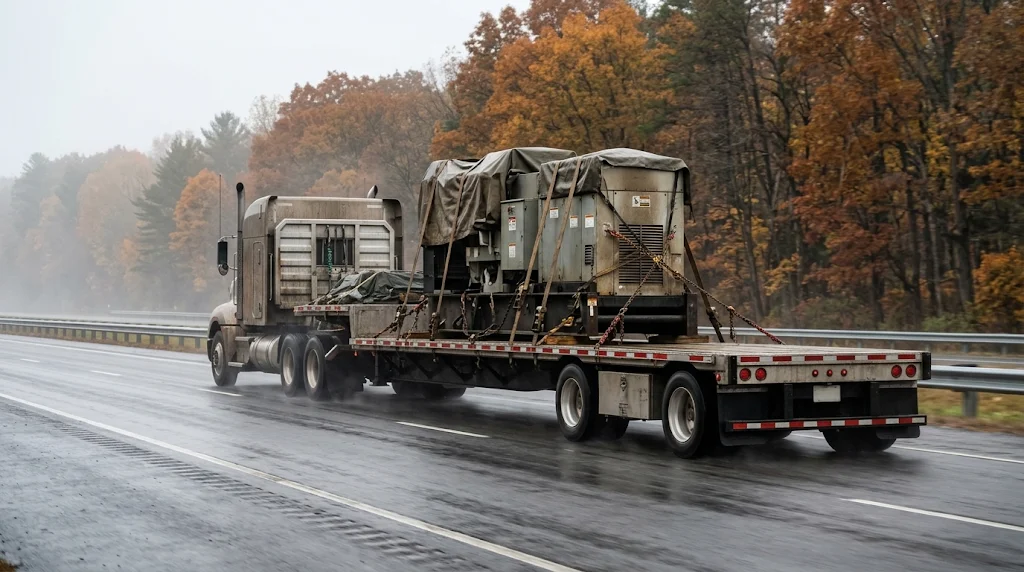
Conestoga was the fastest mover of the month, up 6.4% to $3.85 per mile, which now prices one penny above standard flatbed. Autumn rain is doing the work. A rolling tarp covers a load in two to five minutes, compared with close to an hour for a manual tarp. Consequently, shippers moving finished steel and machinery are accepting a payload tradeoff of about 2,500 pounds in exchange for fewer water-damage claims and less dwell at the dock.
Flatbed and RGN held high
Standard flatbed slipped 0.5% to $3.84 per mile, yet it remains 38.1% above last year. RGN, meanwhile, edged up 0.2% to $5.74, still the highest per-mile rate in the market. Its 31.4% year-over-year gain is the smallest of any equipment type, largely because heavy haul pricing was already elevated a year ago.
Import volume faded after the summer peak
Import loads in our network totaled 606 in October, down 29.5% from September’s 859. Even more notable, that figure runs 46% below the 1,130 loads we handled in October 2025. Volume has declined every month since July’s peak of 1,353, which is consistent with retailers pulling holiday inventory forward into late summer.
Diesel retreated, but regional gaps remain wide
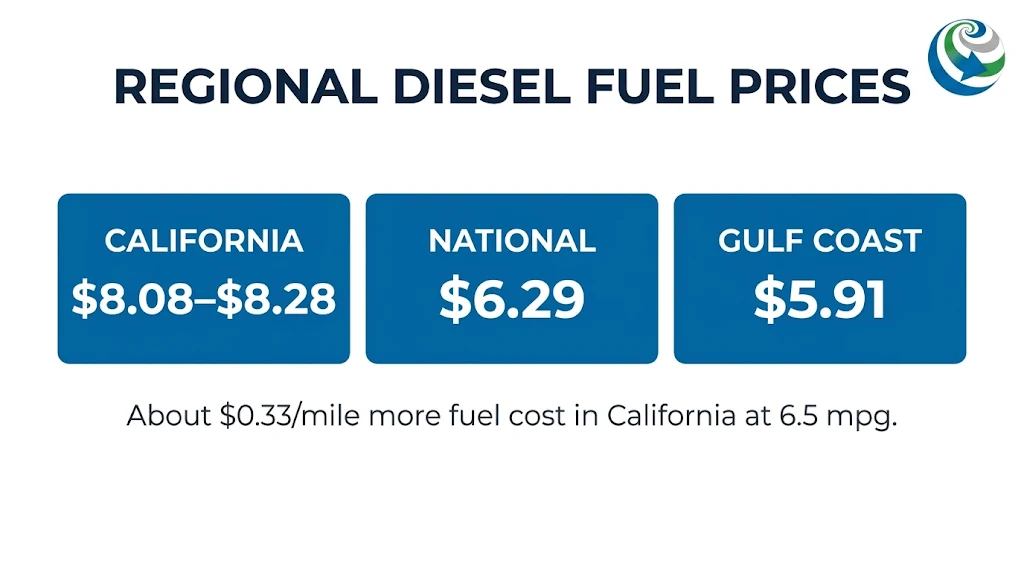
National diesel peaked at $6.529 per gallon in late September and settled at $6.292 on November 2. Regional pricing, however, is far apart. California diesel ran $8.08 to $8.28 per gallon, compared with $5.91 on the Gulf Coast. At 6.5 miles per gallon, that gap works out to roughly $0.33 to $0.36 per mile in fuel cost alone.
October 2026 spot rate benchmarks by equipment type
| Equipment | Oct ’26 | Sep ’26 | M/M | Oct ’25 | Y/Y |
|---|---|---|---|---|---|
| Van | $3.15 | $3.20 | -1.6% | $2.29 | +37.6% |
| Reefer | $3.68 | $3.73 | -1.3% | $2.57 | +43.2% |
| Flatbed | $3.84 | $3.86 | -0.5% | $2.78 | +38.1% |
| Step Deck | $4.65 | $4.57 | +1.8% | $2.59 | +79.5% |
| Conestoga | $3.85 | $3.62 | +6.4% | $2.69 | +43.1% |
| RGN | $5.74 | $5.73 | +0.2% | $4.37 | +31.4% |
“Five cents off van is a pause, not a price cut. Shippers who budget 2027 off last year’s rates will be buying a market that no longer exists, and shippers who budget off September’s peak will overpay for the one that does.”
The Forces Behind the Numbers
The clearest driver of October’s split was timing. According to the NRF and Hackett Associates Global Port Tracker, U.S. ports handled about 2.30 million TEU in August and 2.28 million in September as retailers pulled holiday inventory forward. Distribution centers therefore entered November already stocked, which took pressure off dry van spot pricing.
That said, softer van pricing should not be mistaken for loose capacity. Spot load postings grew more than twice as fast as truck postings in October. Rates eased mainly because fuel backed off and retail demand stabilized, not because trucks flooded back into the market.
It also helps to remember how far the baseline has moved. Quarterly van rates spent most of 2023 through 2025 between about $2.09 and $2.38 per mile. This year, by contrast, they climbed from $2.63 in the first quarter to $3.02, then $3.14, and now $3.15. A one-month dip sits on top of a much larger shift.
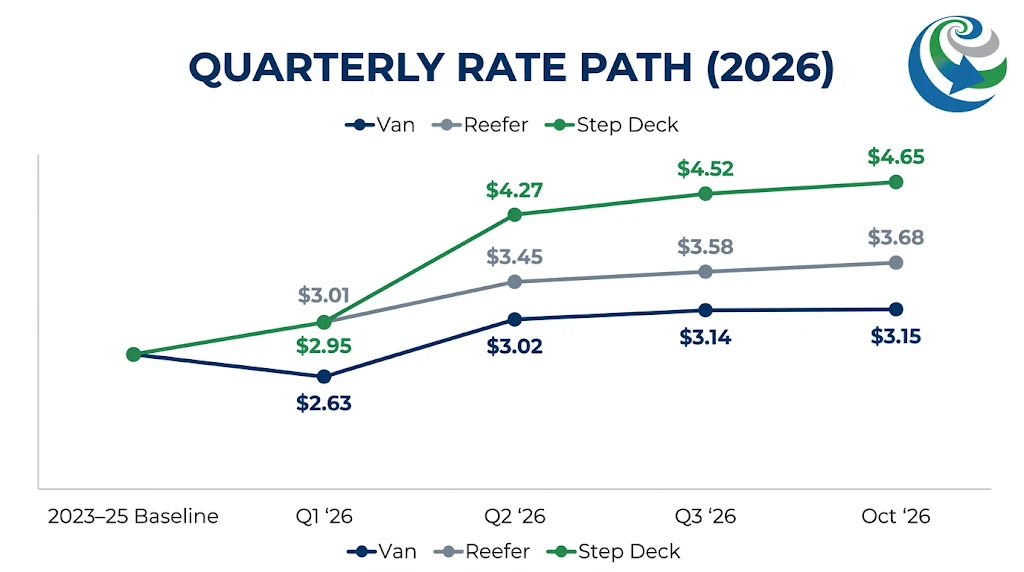
Open deck, on the other hand, is running on a different engine. Federal infrastructure work and private manufacturing investment continue to pull step deck and RGN capacity, so consumer freight can cool without taking specialized equipment with it. Seasonal tarping demand also adds another layer of support for Conestoga through winter.
Cold-chain demand is relocating as well. USDA reports the fall harvest winding down in California and the Pacific Northwest, and reefer activity is shifting toward Mexican produce imports crossing at Nogales and through South Texas. In short, demand is moving south rather than disappearing.
Finally, the share of loads moving below carrier cost continued to shrink, falling from 7.2% in September to 6.7% in October. By comparison, roughly one in nine loads moved at a loss this spring. Shippers should read that trend as a subsidy being withdrawn. Lanes that were priced low earlier in the year are the ones most likely to come back for adjustment at renewal.
What This Means for Shippers
- Price 2027 off the current range. September’s $3.20 van peak overstates the market, and 2025 rates understate it. Therefore, build contract budgets off where rates sit today.
- Commit step deck capacity now. Rates are up 79.5% in a year and still rising. So if you move machinery or infrastructure freight, secure committed trucks rather than relying on spot coverage.
- Run the Conestoga math on weather-sensitive freight. At a penny over flatbed, faster tarping and fewer damage claims on steel and machinery can more than cover the payload tradeoff this winter.
- Index fuel by region. A gap of more than $2 per gallon between the Gulf Coast and California is too wide for one national surcharge. Instead, use regional formulas that reflect what carriers actually pay.
- Plan winter reefer around the southern border. As domestic harvests taper, line up capacity for Nogales and South Texas before produce volume peaks there.
- Review your lowest-priced lanes before renewal. As below-cost freight disappears, those lanes are the first to reprice. Identify yours now instead of during bid season.
- Watch import volume as an early signal. If imports stay low into the first quarter, van capacity should stay balanced. A rebound, however, would bring pressure back quickly.
About Circle Logistics
Circle Logistics is a technology-forward freight brokerage specializing in truckload, reefer, flatbed, and specialized equipment freight. Powered by real-time market data and a performance-driven culture, Circle helps shippers and carriers navigate volatility with confidence.
Rate, volume, and capacity figures reflect internal lane-level pricing data for October 2026, with external benchmark verification from DAT Trendlines, the U.S. Energy Information Administration, USDA, and the NRF/Hackett Associates Global Port Tracker.